

AttritionGuard — Self-Healing MLOps Platform for Workforce Analytics
AttritionGuard is an enterprise MLOps solution that predicts and monitors attrition risk among AI-augmented knowledge workers. Built for HR analytics leaders, it runs a self-healing pipeline that tracks shifting workplace sentiment while automatically safeguarding model prediction quality in production.

Self-Healing Intelligence for Workforce Risk
- The Challenge Predicting burnout involves highly dynamic features like fear of AI replacement, productivity score, and burnout score. As workplace behavior shifts with new tools and processes, statistical data drift silently degrades model accuracy. The challenge was building infrastructure that logs real-time risk forecasts while autonomously catching and correcting that degradation before it affects HR decisions.
- Complexity and Innovation Retraining is purely conditional — Evidently AI runs statistical drift checks against a reference baseline, and a full retrain only triggers once drift share crosses a 50% threshold. Deployment is guarded by a champion-challenger governance model: using MLflowClient, a new candidate must beat the production model's test accuracy by at least 2% before earning the production alias. A dual-layer logging system aggregates live predictions into sliding micro-batches of 10, tracking Low/Medium/High risk distribution shifts back into MLflow.
- The Process We worked with HR data teams to map workplace behaviors into structured feature vectors, then split the system into clean microservices: an inference endpoint, a centralized telemetry server, and a weekly automated health-check scheduler.
- Conditional Intelligence Over Constant Retraining AttritionGuard replaces blind, calendar-based retraining with a system that only acts when the data actually demands it.
Feature Inventory
Building Statistically-Aware, Self-Correcting ML Pipelines AttritionGuard combines drift detection, governance, and telemetry into one closed-loop system.
- Conditional retraining loop triggered only by significant data drift
- Multi-model hyperparameter search across five algorithms (Random Forest, Decision Tree, XGBoost, SVM, Logistic Regression)
- Comprehensive performance telemetry logged to MLflow for full auditability
- Statistical data drift profiling with HTML diagnostic reports
- Dynamic preprocessing pipelines for live categorical and numerical inputs
- Target distribution monitoring to catch shifts in risk groupings
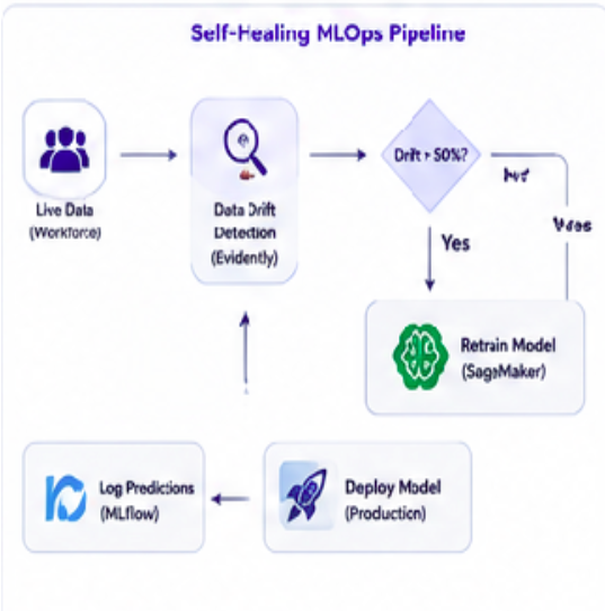
"By embedding continuous drift detection alongside champion-challenger governance, we turned a volatile classification task into a self-healing production system."
Transforming Workforce Risk Monitoring
Blending Statistical Rigor with Automated Governance Every retraining and deployment decision in AttritionGuard is backed by hard statistical evidence, not a schedule.
- Intelligent Drift Gating: Retraining triggers only when statistical drift crosses a 50% threshold.
- Champion-Challenger Governance: New models must beat production accuracy by 2% before promotion.
- Dual-Layer Production Logging: Real-time predictions are logged and aggregated for distribution tracking.
- Automated Weekly Orchestration: Prefect schedules and manages the full retraining workflow.
- Full Experiment Auditability: MLflow logs every dataset, hyperparameter, and metric for traceability.
- Serialized Preprocessing: Joblib pipelines normalize incoming data consistently at inference time.
Conclusion
Delivering Continuously Validated Workforce Insights AttritionGuard gives HR leaders warnings they can trust, generated by a system that maintains itself.
- Operational Efficiency: Automated drift testing and deployment eliminated manual model maintenance.
- Resource Cost Optimization: Conditional retraining avoided unnecessary compute usage.
- Inference Reliability: A mandatory 2% improvement threshold protected production accuracy.
- Proactive Risk Intervention: Continuously validated attrition warnings enabled early workforce action.
- Full Auditability: Comprehensive MLflow logging ensured transparent, traceable model governance.