
Exam Tutor is an AI-powered adaptive learning platform designed to help students prepare for examinations through personalized tutoring and intelligent assessments. Built with a modular architecture, the system uses Large Language Models (LLMs) to generate curriculum-specific questions, evaluate learner performance, provide detailed explanations, and continuously adapt quiz difficulty. It supports both cloud-based LLMs and fully offline local models, making it suitable for flexible educational environments.
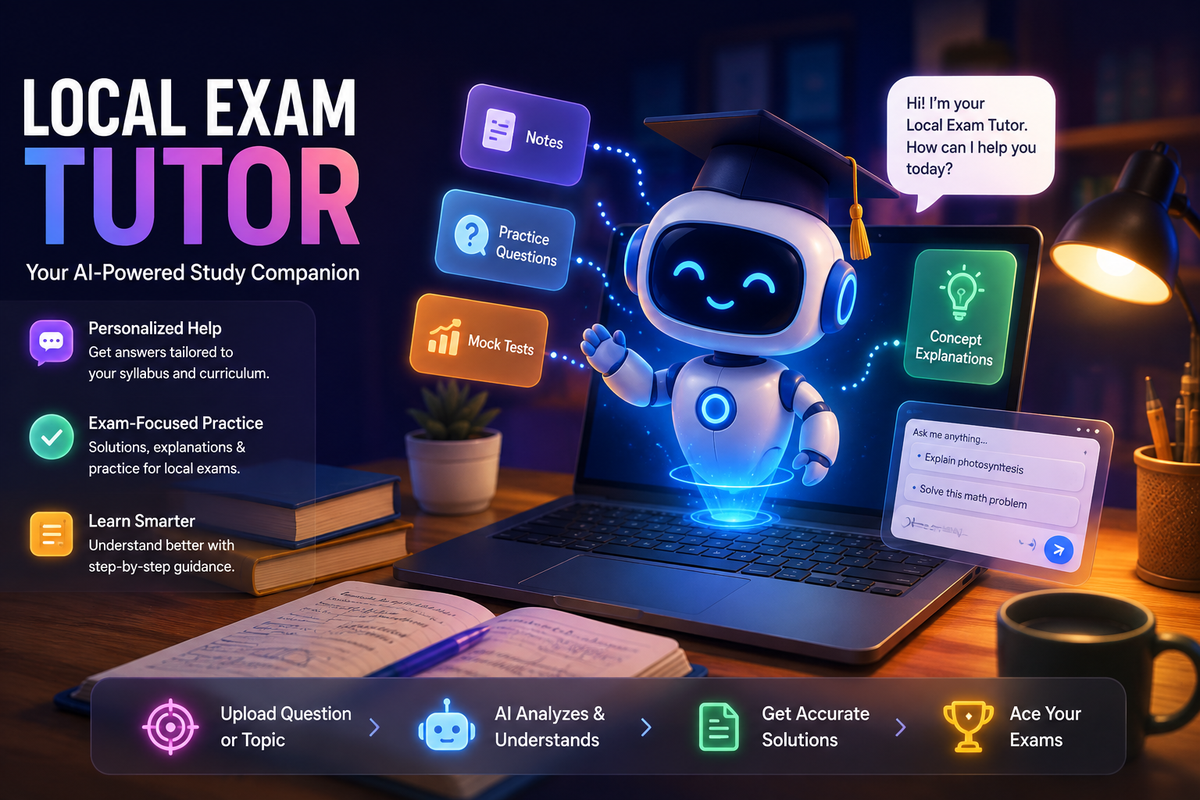
Developing an intelligent tutoring system requires more than generating questions—it must personalize learning based on student performance, provide meaningful explanations, and preserve learning progress across sessions. The system also needs to maintain consistency in assessments while adapting to different learning levels and identifying topics where students require additional practice. The challenge was to design a modular AI application capable of supporting multiple LLM providers, offline inference through GGUF models, adaptive assessments, and persistent learner analytics while remaining easy to configure and extend. It also needed to provide flexible model integration, reliable progress tracking, and a consistent learning experience across different deployment environments and user requirements.
The platform continuously adjusts question difficulty using a Bayesian knowledge tracing algorithm that considers student accuracy and response time. This creates a personalized learning experience where questions become progressively easier or more challenging based on the learner's demonstrated mastery.
Students can upload PDF and DOCX study materials, which are converted into vector embeddings for context-aware question generation and explanations. This allows the tutor to generate quizzes directly from custom learning resources instead of relying solely on predefined curricula.
The application supports both cloud-based LLM providers and fully offline inference using GGUF models through llama.cpp. Users can switch between different models via configuration files, enabling flexible deployment in environments with or without internet connectivity.
Exam Tutor demonstrates the practical application of AI in personalized education by combining adaptive assessments, intelligent content generation, and flexible model deployment within a modular tutoring platform. It is designed for students preparing for examinations, educators building AI-assisted learning environments, and developers exploring intelligent educational systems powered by Large Language Models. The platform enables personalized learning by analyzing student performance, adapting question difficulty, and providing meaningful explanations based on individual learning needs. With support for both cloud-based and local LLMs, Exam Tutor offers flexibility across different environments while maintaining learner progress and analytics. Its modular and extensible design also provides a strong foundation for future enhancements, making it suitable for building scalable and intelligent examination preparation solutions.