
The Model Lifecycle Management System (MLMS) is a framework designed to manage the complete lifecycle of machine learning models, from development and versioning to testing, deployment, monitoring, and retirement. It provides a centralized and extensible platform for managing model artifacts, metadata, validation pipelines, deployments, and monitoring while promoting reproducibility, compliance, and operational efficiency.
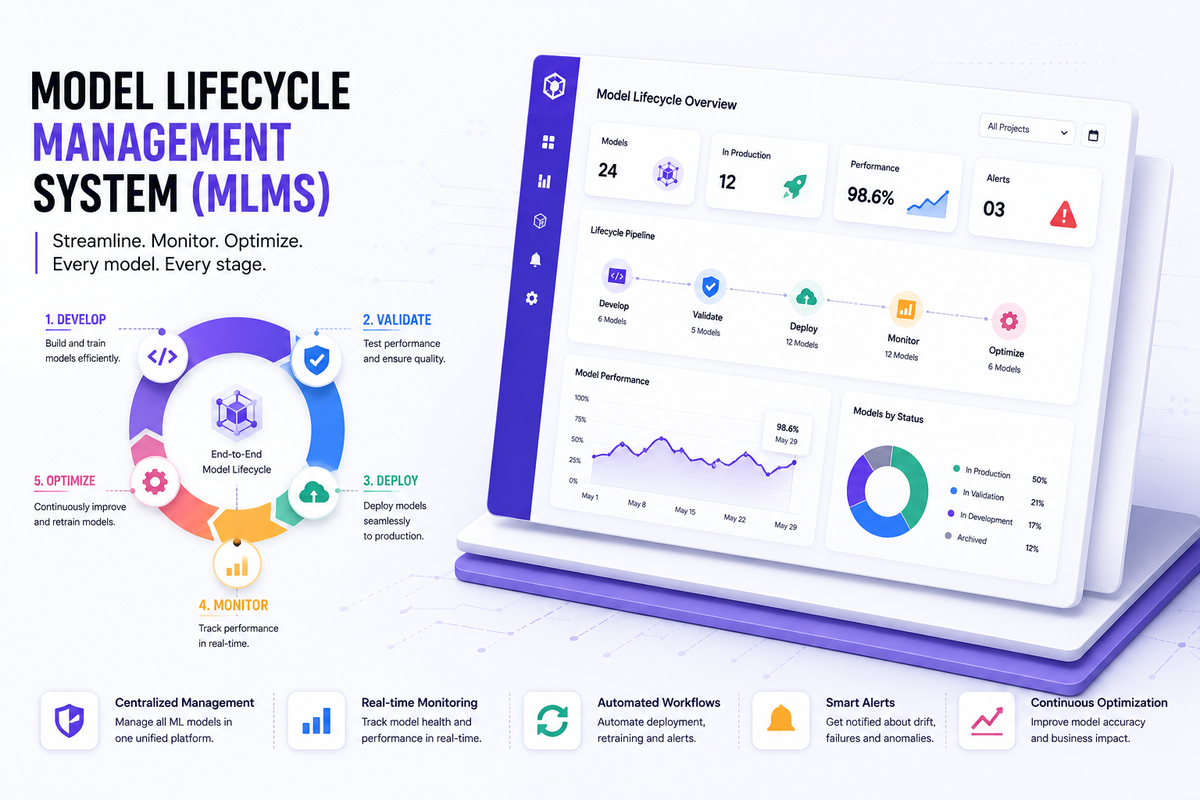
Managing machine learning models across multiple lifecycle stages requires consistent versioning, validation, deployment, monitoring, and governance. As the number of models increases, maintaining model versions, metadata, artifacts, and deployment history can become complex and difficult to manage.The challenge was to design a centralized framework that organizes these processes while maintaining model traceability, reproducibility, and extensibility through a unified workflow. The framework also needed to reduce manual effort, standardize validation and approval processes, provide clear lifecycle visibility, and support seamless integration with existing machine learning workflows.
The system maintains a centralized registry for model versions, metadata, lineage, and artifacts. It supports semantic versioning and immutable artifacts, allowing teams to manage and track models throughout their lifecycle.
MLMS provides built-in commands for registering, validating, promoting, deploying, auditing, and managing models. These lifecycle stages are exposed through both a command-line interface and a Python SDK, simplifying model management workflows.
The framework includes monitoring and observability capabilities through metrics, structured logging, and traceability. It also maintains audit trails for training data, hyperparameters, and evaluation metrics, supporting visibility throughout the model lifecycle.
The Model Lifecycle Management System (MLMS) provides a centralized framework for managing machine learning models across their entire lifecycle. By combining version management, validation, deployment, monitoring, and auditing into a single system, it streamlines model management while improving organization, traceability, and operational consistency. It also provides clear visibility into model versions, artifacts, metadata, and deployment status.The framework promotes reproducibility, governance, and collaboration by ensuring that models follow standardized processes throughout their lifecycle. With automated operations and an extensible architecture, MLMS provides a scalable and reliable foundation for managing models from development and testing through production deployment, monitoring, and eventual retirement.