Challenge
Scientific research is increasingly dataâintensive and interdisciplinary. Existing tools either excel at statistical pattern detection (neural nets) or rigorous logical deduction (symbolic AI), but rarely both. Researchers need a system that can:
- Navigate massive literature without drowning in noise.
- Maintain provenance of every inference to satisfy peer review.
- Adapt to evolving ontologies as new concepts emerge.
- Balancing these requirements while delivering a responsive UI is the core challenge.
Complexity & Innovation
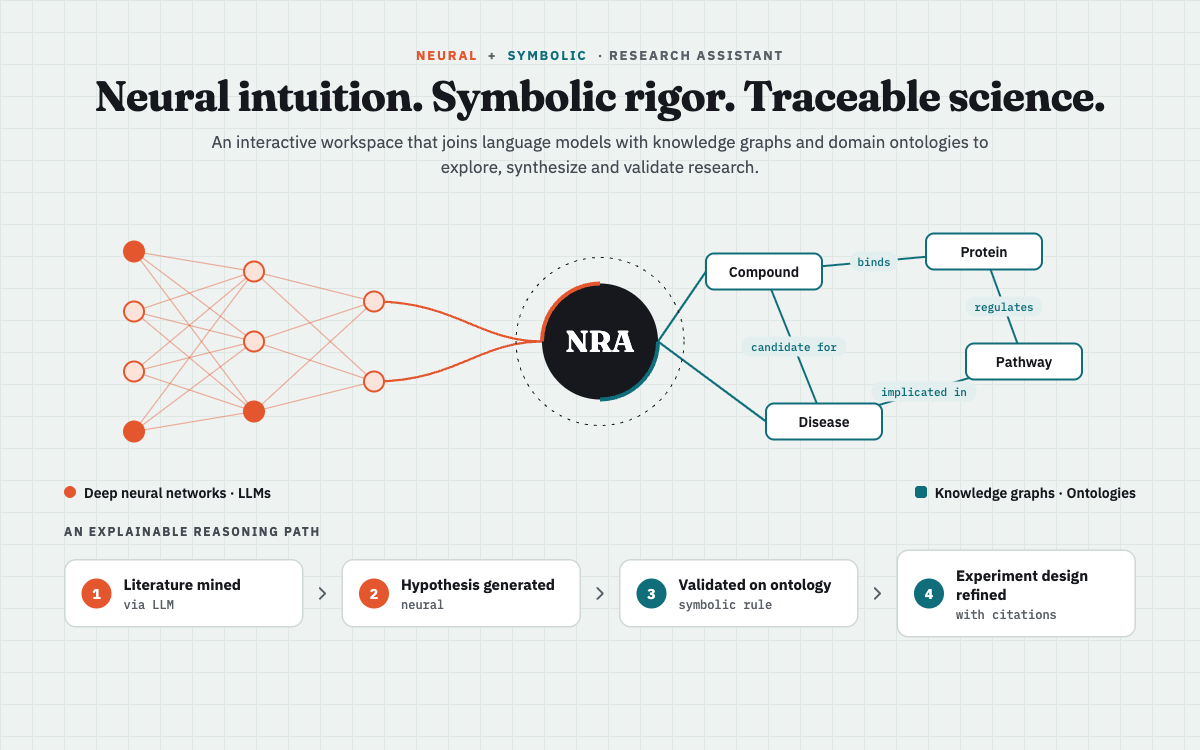
- Hybrid Architecture: Seamlessly pipelines neural embeddings into a symbolic reasoning layer, enabling âneurosymbolic loopsâ where the LLM proposes hypotheses and the rule engine validates or refutes them.
- Dynamic Knowledge Graph Updates: Ingestion pipeline to upload Research papers and extracts Entities and Relationships to create knowledge graph
- Explainable AI: Every LLMâgenerated claim is accompanied by a traceable chain of symbolic deductions and supporting evidence nodes, satisfying reproducibility standards.
- Scalable Retrieval: Multiâmodal indexing (vector + graph) allows subâsecond retrieval of relevant concepts across heterogeneous data stores.
The Process
- Ingestion â Raw PDFs/metadata are parsed, converted to text embeddings, and inserted into both the FAISS index and Neo4j graph.
- Query Understanding â User prompts are processed by the LLM, which extracts key entities and intents, then maps them to graph queries.
- Symbolic Reasoning â The rule engine applies domainâspecific axioms (e.g., âif a protein interacts with X, then X may affect Yâ) to generate logical deductions.
- Neural Generation â The LLM synthesizes a naturalâlanguage answer, weaving together retrieved evidence and inferred conclusions.
Feature Inventory
- The NRA offers a comprehensive suite of capabilities that transform the way scholars conduct investigations. Its Literature Navigator empowers users to pose complex questionsâsuch as âWhat are the latest mechanistic links between mitochondrial dysfunction and neurodegeneration?ââand receive a concise synthesis backed by a graph of citations, experimental data, and inferred pathways.
- The Hypothesis Builder lets researchers draft provisional models, automatically checks them against existing knowledge using the symbolic engine, and highlights inconsistencies or missing evidence.
- A Collaborative Workspace integrates realâtime comment threads, versioned notebooks, and exportable LaTeX reports, ensuring that interdisciplinary teams can coâauthor while preserving the provenance of each insight.
- Finally, the Automation Hub provides programmable hooks (Python scripts, webhooks) that trigger downstream analysesâsuch as running a molecular dynamics simulation when a new ligandâtarget interaction is inferredâclosing the loop from insight to experiment.
Conclusion
- For researchers, developers, and organizational leaders alike, the Neurosymbolic Research Assistant offers a single, cohesive platform that bridges the gap between massive, unstructured scientific literature and rigorous, explainable reasoning.
- By fusing stateâofâtheâart language models with a transparent symbolic engine and a dynamically updated knowledge graph, the assistant accelerates hypothesis generation, reduces duplicate effort, and enhances reproducibilityâall within an intuitive, collaborative workspace.
- Whether you are drafting a grant, designing an experiment, or building downstream analytical pipelines, the NRA delivers trustworthy, evidenceâbacked insights at the speed of modern research, empowering your team to focus on true innovation rather than data wrangling.