Challenge
Creating a high-quality marketing strategy requires combining company knowledge with constantly changing market trends while maintaining consistency across all generated content. The main challenge was building a reliable AI workflow that could intelligently interpret user requests, ensure every selected service was represented, incorporate live industry insights, and generate structured outputs without exposing internal reasoning or failing when an LLM provider becomes unavailable. The workflow also needed to coordinate multiple specialized AI agents while maintaining a consistent flow of information between each stage. It was important to ensure that market research, service matching, messaging, and campaign planning remained aligned with the original campaign brief and business objectives. Additionally, the system needed to produce professionally structured documents with minimal manual intervention while remaining flexible enough to support different regions, industries, audiences, and marketing requirements.
Complexity & Innovation
- The project combines deterministic workflow orchestration with AI reasoning instead of relying on a single prompt. It uses a hierarchical service-matching mechanism (exact match, token overlap, and LLM-assisted semantic matching) to prevent services from being ignored or incorrectly interpreted.
- Live market context from NewsAPI enhances the relevance of recommendations, while a multi-provider fallback chain (Groq → OpenRouter → Sarvam AI) ensures high reliability. Additionally, an internal SWOT analysis guides content generation without appearing in the final document, separating AI reasoning from customer-facing outputs.
Process
- Collect campaign details through CLI or Streamlit.
- Load SparkBrains' company intelligence profile.
- Match requested services using exact, token-overlap, and LLM-assisted matching.
- Retrieve relevant industry news using NewsAPI.
- Perform an internal SWOT analysis for strategic reasoning.
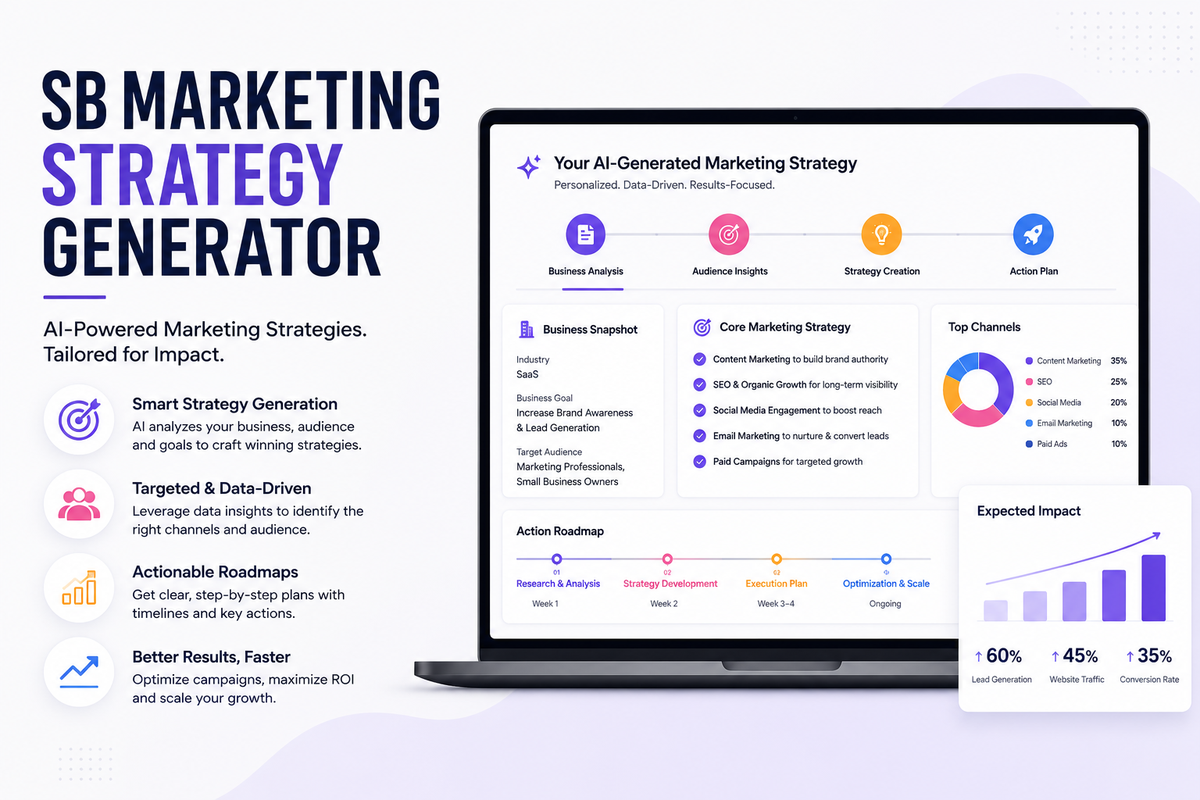
- Generate positioning, service messaging, campaign themes, posting cadence, and sample content through LangGraph nodes.
- Render the approved outputs into a professionally formatted .docx strategy document.
Feature Inventory
- Company Intelligence Integration: Every generation step references SparkBrains' structured company profile, maintaining consistency with the organization's services, branding, and tone of voice.
- Live Market Trend Analysis: The system retrieves recent industry news through NewsAPI, allowing recommendations and campaign ideas to reflect current market conditions instead of static templates.
- Modular AI Workflow: Individual LangGraph nodes handle positioning, messaging, campaign planning, and content generation independently, making the workflow easier to maintain, extend, and debug.
Conclusion
- The SparkBrains Marketing Strategy Pipeline demonstrates how agentic AI workflows can automate strategic content planning by combining structured company knowledge, live market intelligence, and modular AI orchestration. By coordinating specialized agents for service matching, market analysis, messaging, campaign planning, and document generation, the system creates a structured and reliable approach to developing marketing strategies.
- The system delivers consistent, region-specific marketing strategies with minimal manual effort, making it well suited for marketing teams, business development professionals, digital agencies, and organizations seeking scalable AI-driven content strategy generation. Its modular architecture also provides flexibility for incorporating new services, markets, data sources, and AI capabilities as business and marketing requirements evolve.