As search shifts from traditional "blue link" results to direct answers inside ChatGPT, Google AI Overviews, and Perplexity - a behaviour known as "zero-click search" - brands need a way to make sure AI assistants can find, understand, and recommend them. This project is the LLM-powered backend engine behind a platform that automatically builds a structured intelligence profile of a brand, maps its competitors, models the questions real customers ask AI assistants, audits existing content for AI-readability, and generates AI-optimized content and metadata - turning what used to be days of manual brand research and SEO auditing into a few automated pipeline runs.

Give any brand a structured, machine-readable identity (industry, audience, offerings, market, competitors) generated directly from its own website.
Discover and rank real local competitors automatically, with strict rules to prevent hallucinated or fabricated businesses.
Model the natural-language questions people actually ask AI assistants about a brand, and generate content that is more likely to be quoted or cited by those assistants.
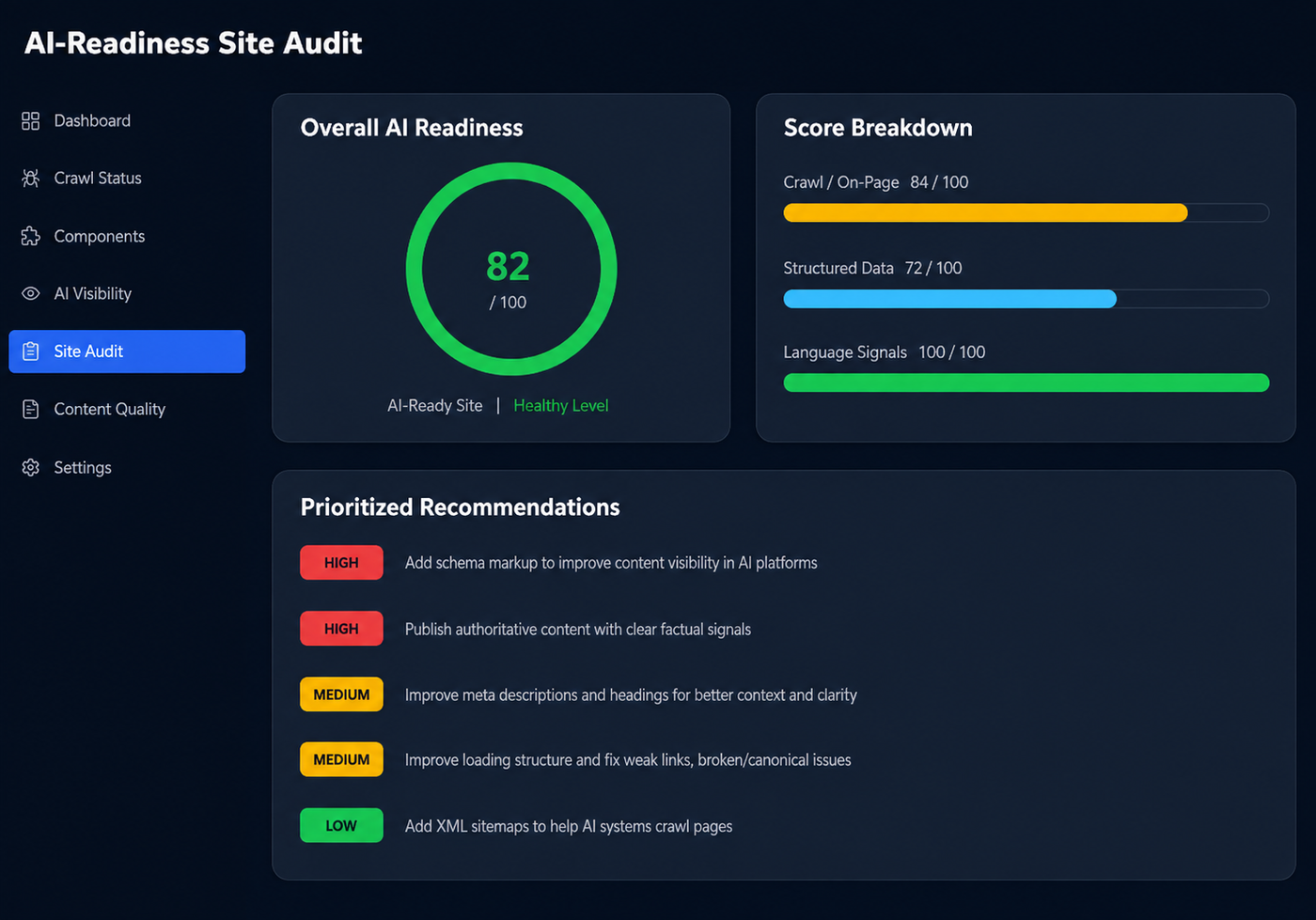
Score and improve how "AI-readable" a webpage already is, and turn that score into a prioritized action plan.
Auto-generate SEO/schema metadata so every piece of content is structured for both traditional search engines and AI crawlers.
Reads a brand's website content and converts it into strict, structured JSON: brand name, industry (from a fixed taxonomy), sub-industries, aliases, a compact analyst-style description, and a mission statement. It goes on to build out deep customer pain-point and buyer-persona profiles, product/service and value-proposition breakdowns, market and technology-ecosystem analysis, core values, and a three-tier competitor list - with every list field constrained to a strict item count and conservative-inference rules so nothing comes back empty or hallucinated. Only verified social and directory URLs found in the page content are extracted.
Improves specific fields of already-generated brand data instead of regenerating everything from scratch - correcting anything that conflicts with the live website, expanding thin descriptions to the required depth, and preserving good existing content rather than overwriting it with generic filler.
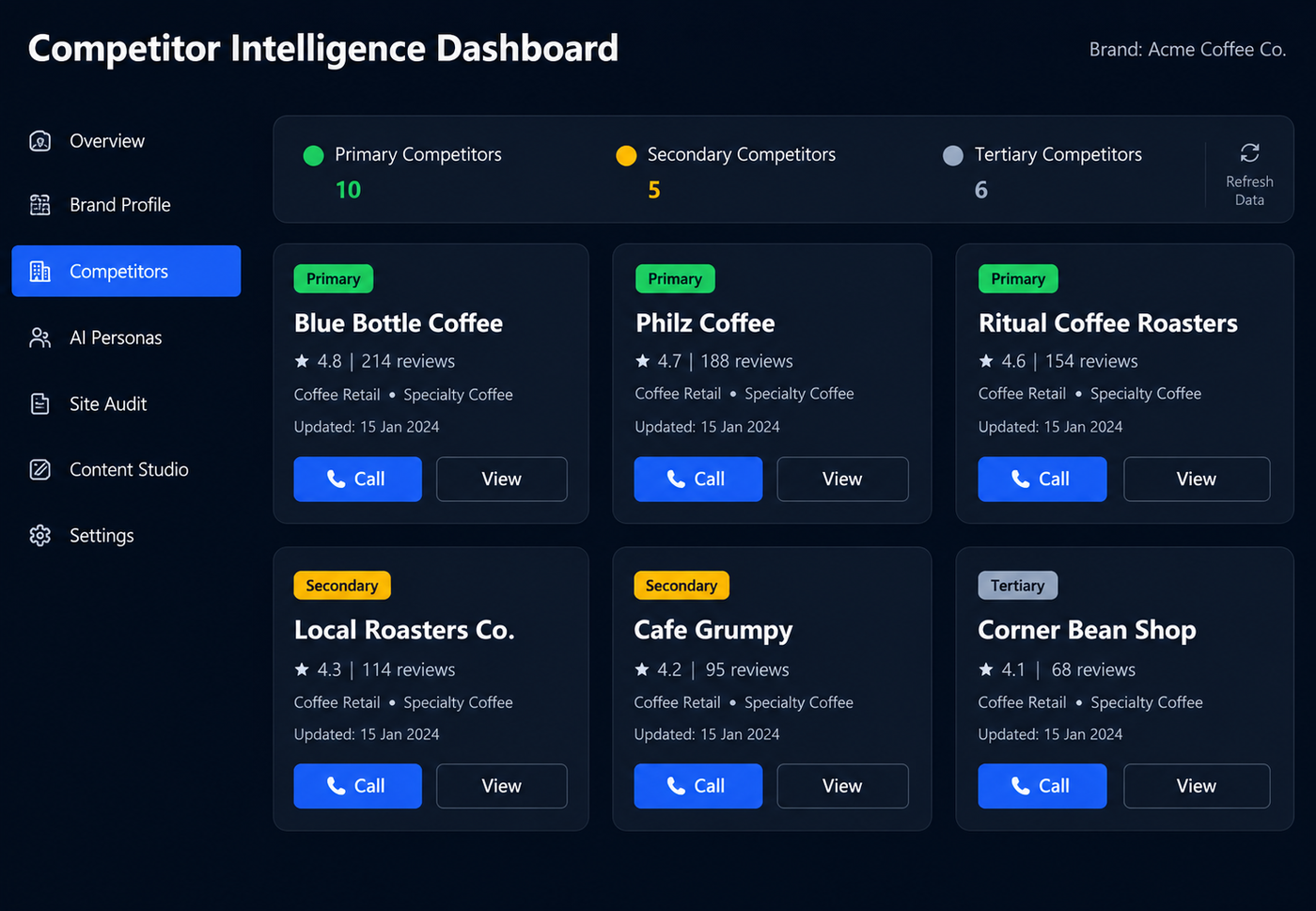
Given a brand's coordinates and a search radius, identifies 10–15 real, verifiable local competitors. Distance is enforced with the Haversine formula as a hard cut-off, placeholder or SEO-generated business names are rejected, and results are deterministic so the same brand always returns essentially the same competitor set.
Re-scores a candidate competitor list against the brand's own intelligence profile, drops anything outside the radius or below a competitive-score threshold, and classifies survivors into Primary, Secondary, or Tertiary tiers based on sub-industry similarity, service overlap, geography, and customer overlap - evaluated in a fixed order so results stay reproducible.
Selects the most relevant customer "intents" for a brand from a master list, then generates realistic, natural-language questions a real consumer might ask ChatGPT, Google AI, or Perplexity about the brand - deliberately mixing branded and unbranded phrasing across comparisons, pricing, features, reliability, and "best for..." style questions. This is what lets the platform optimize content for how people actually query AI assistants, not just search engines.
Scores a single webpage's readiness to be cited by AI answer engines using three weighted signals - direct quotes, factual statistics, and language quality - and turns that into a plain-language rating (Critical to Excellent) plus four specific, prioritized recommendations that target root causes rather than generic "improve your SEO" advice.
Aggregates page-level audit results across an entire crawled site into one prioritized improvement plan - merging duplicate themes and surfacing the 5–8 highest-impact, site-wide action items with clear priority and impact ratings.
Auto-generates valid Article/BlogPosting JSON-LD markup - author, publisher, and page metadata - always crediting the brand as an Organization, and cleanly omitting any field left empty. This improves how reliably search engines and AI crawlers can parse and cite the content.
Produces a complete SEO metadata bundle for every article: meta title, meta description, image alt texts, content tags, social preview text, email subject line, schema recommendations, and internal link suggestions - all generated from the article's title, topic, and target keywords.
Generates SEO-optimized, non-branded, reader-facing article titles aligned to real search intent and the brand's configured tone and content pillars - avoiding clickbait and vague phrasing.
Given just a competitor's name and website, fills in a factual profile - description, industry, sub-industry, and market position (leader, challenger, niche, or follower) - grounded strictly in real, known information rather than speculation.
Lightweight classifier prompts map free-text industries to the platform's internal taxonomy and to the correct Google Places business type, powering automatic business categorization during onboarding.
A shared instruction block appended to relevant prompts that forces every brand or business claim to be backed by a real, publicly verifiable URL - official site, directory listing, or social profile - never a fabricated one, keeping generated content factually trustworthy.
Brands had no reliable way to know how AI assistants like ChatGPT, Google AI Overviews, or Perplexity perceive and represent them, since these systems synthesize answers instead of returning links. Manually researching a brand's identity, mapping real local competitors, guessing what questions AI assistants get asked, and auditing dozens of pages for AI-readability was previously days of manual analyst work per brand, with high risk of inconsistent, fabricated, or hallucinated competitor and content data if automated naively.
every extraction, tiering, and scoring step is constrained with strict JSON schemas, fixed item counts, and ordered scoring criteria so the same brand input reliably produces near-identical output run after run.
Haversine distance is enforced as a non-negotiable cutoff before any LLM judgment is applied, preventing the model from including plausible-sounding but geographically invalid competitors.
a discovery engine first proposes 10-15 candidates, then a separate validation/tiering engine re-scores and classifies them into Primary/Secondary/Tertiary using five ordered criteria, catching hallucinations that a single-pass approach would miss.
a shared, reusable prompt instruction block appended across multiple engines that forces every business or brand claim to carry a real, verifiable URL, directly addressing LLM hallucination risk at the source.
rather than optimizing for keyword search, the Intent & AI-Prompt engine models the actual natural-language questions people type into AI assistants, deliberately mixing branded and unbranded phrasing to mirror real usage patterns.
combining direct quotes, factual statistics, and language quality into a single explainable score with plain-language ratings, avoiding a black-box number with no actionable path.
A single, LLM-driven pipeline that replaces what would otherwise be manual brand research, competitor mapping, SEO content auditing, and schema markup work - purpose-built for the emerging "zero-click" era where users increasingly get their answers directly from AI assistants instead of clicking through to a website.