

VeriRAG — Self-Evaluating Agentic RAG Platform
VeriRAG is a self-correcting Retrieval-Augmented Generation agent that dynamically validates data source relevance and orchestrates queries between a local knowledge base and web search tools, enforcing secure data boundaries while providing continuous tracing and automated prompt performance profiling.
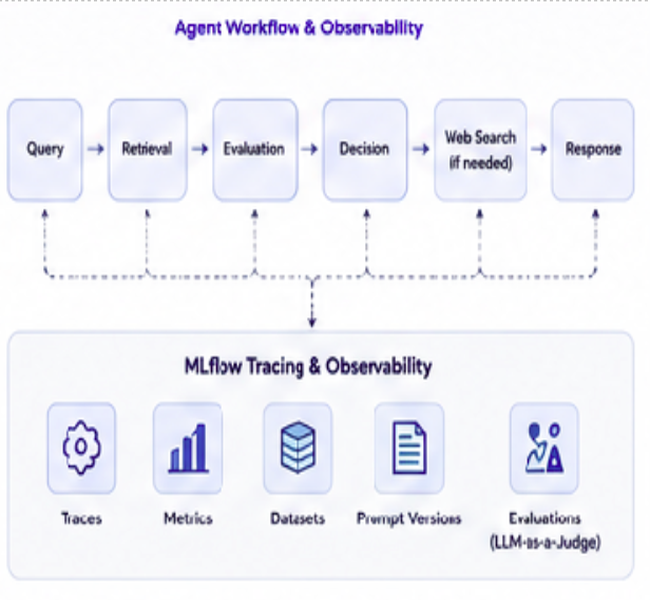
Verifying Every Answer Before It's Trusted
- The Challenge Standard RAG systems hallucinate when internal documentation is incomplete, ambiguous, or irrelevant to a query. The goal was an autonomous agent that scores retrieved context quality mid-flight and dynamically seeks external validation via web search when needed — all while keeping sensitive user data out of persistent model telemetry.
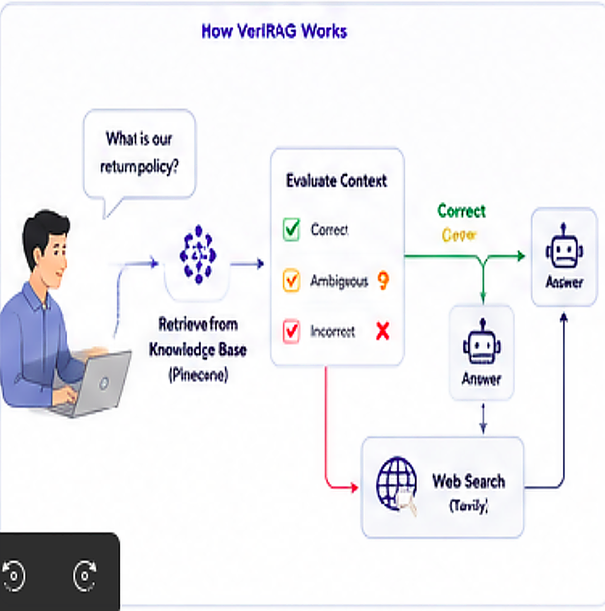
- Complexity and Innovation An evaluation node classifies retrieved context as Correct, Ambiguous, or Incorrect relative to user intent using structured outputs. The graph then branches programmatically: accurate context proceeds to refinement, while ambiguous or incorrect matches instantly trigger a live web search via Tavily. Custom span processors hook into the MLflow tracking cycle to automatically detect and redact personal email addresses from traces in real time.
- The Process We combined LangGraph state graphs with FastAPI endpoints for a fast, modular backend, then integrated MLflow's GenAI evaluation engine to run prompt variant tests, scoring iterations on safety, answer accuracy, and style before promoting them to production.
- Self-Verifying Answers, Zero Blind Trust VeriRAG treats retrieval quality as an active decision point rather than a passive assumption, catching weak context before it reaches the user.
Feature Inventory
Engineering Trustworthy, Self-Correcting Retrieval VeriRAG closes the loop between retrieval, evaluation, and continuous prompt improvement.
- Intent query router separating conversational queries from document-dependent lookups
- Self-evaluating retrieval node with Pydantic validation on vector outputs
- Web search failover for out-of-knowledge-base topics
- Automated telemetry redaction to scrub PII from traces
- LLM-as-a-judge evaluation scoring safety, accuracy, and relevance
- Prompt registry comparison against real validation datasets
"Moving from linear RAG pipelines to state-graph agent networks let us turn retrieval evaluation into an active decision, not an afterthought."
Transforming Agentic RAG Reliability
Blending Structured Evaluation with Adaptive Retrieval VeriRAG's architecture makes context quality a first-class decision in every response cycle.
- Multi-Tier Structured Routing: Classifies retrieved context as Correct, Ambiguous, or Incorrect before generation.
- Dynamic Fallback Switching: Automatically triggers web search when retrieved documents fall short.
- In-Flight Data Sanitization: Redacts personal information from traces before they're saved.
- State-Graph Architecture: LangGraph orchestrates multi-step reasoning across agent states.
- Judge-Based Quality Scoring: Evaluates responses on safety, accuracy, and relevance automatically.
- Prompt Version Benchmarking: Compares prompt iterations against real validation datasets.
Conclusion
Delivering Verified, Privacy-Safe AI Responses VeriRAG proved that self-verification and strict privacy compliance can scale together in production.
- Reduced Hallucinations: Dynamic context validation and web fallback minimized inaccurate responses.
- Strict Privacy Compliance: Automated PII redaction secured sensitive data in telemetry.
- Accelerated Optimization: Automated LLM evaluation replaced slow manual testing cycles.
- Improved Response Quality: Judge-based scoring maintained consistently high safety and accuracy standards.
- Full Observability: MLflow tracing gave complete visibility into agent decision paths.